

When Culture Becomes a Weapon: The Conductor’s Perspective on Eugene Onegin Today
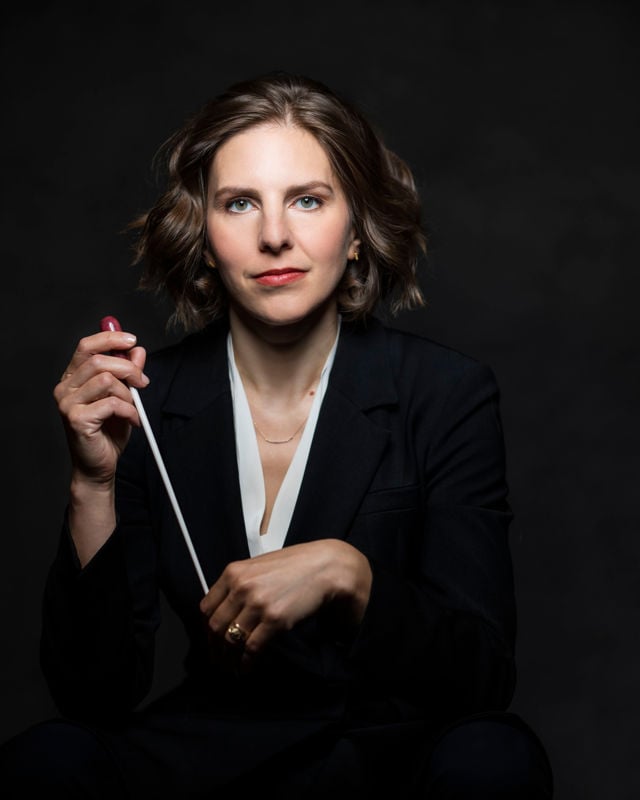 Lidiya Yankovskaya / Photo: Todd Rosenberg
Lidiya Yankovskaya has just arrived at the Norwegian National Opera & Ballet to conduct Tchaikovsky’s best-known opera, Eugene Onegin. She was born in Russia and immigrated to the United States as a refugee in 1995, where she spent most of her life until a recent relocation to London. Yet Onegin– or Yevgeny Onegin – has always been with her:
– Eugene Onegin is an opera I grew up with; it’s almost in my DNA. Alexander Pushkin (on whose work the opera is based) is not only a Russian author, but is a part of humanity's literary heritage. It's also important to note that he was part African, so he was both part of Russia's society and always an outsider looking in, which led to a huge body of work (including Onegin) that looked at Russian society of his time through a critical lens. As an opera, the music is incredibly nuanced – layer upon layer, stories within stories. Every time I conduct Eugene Onegin, I find something new in it. That’s the sign of a brilliant work, says Yankovskaya.
Can we perform Russian works now?
Since Russia’s invasion of Ukraine, however, the opera has taken on yet another story – one about how the Kremlin’s cultural policy uses Tchaikovsky to serve its own purposes. At the Opera House, too, the debate has surfaced: are cultural institutions naïve when they stage Russian classics in wartime – or do they in fact safeguard our shared artistic heritage by continuing to perform them?
– I completely understand the anger at this senseless war and the desire to respond strongly. I still have many close family members in Ukraine and I spent my childhood summers there. Many people – including Russian-speaking Ukrainians – are actively promoting and celebrating Ukranian culture and language, which is wonderful. We are seeing a proliferation of the Ukranian language, more Ukranian musical works being featured – this is very positive. There are also many sanctions in place that hurt Putin's cause economically and politically. However, I do not think that boycotting artistic works like Onegin hurts Putin's political agenda, while it deprives audiences of experiencing immensely powerful art. Furthermore, Onegin in particular revolves around themes that reflect on the mechanisms that can lead world leaders to make poor decisions.
– How do you relate to the debate about whether Eugene Onegin – and Russian works in general – should be performed at all right now?
– This opera is about making mistakes, about the cost of arrogance, and about the importance of being vulnerable. Onegin is a man who looks down on others, has the need to assert his dominance and expertise, and in the end, finds that his choices have isolated him. That’s a lesson for all of us – and perhaps for many world leaders, too. It’s also important to remember that the novel and the opera were written in a Russia that no longer exists. I very much hope we don’t discard parts of our shared international cultural heritage because individual leaders make horrendous decisions that destroy lives and countries today.
– Furthermore, performing these works lead us to dialogue and debate, which may lead to more powerful and practical solutions to ending the war. Even if it shares relevant themes, a performance of a French or Italian work is unlikely to lead to extensive conversation about this topic. It's important that this performance leads to conversation and action--isn't that what art is about?
The narrative of «cancellation»
Yankovskaya emphasizes that the question of Russian culture is not black and white – there is a difference between art created in close relation to a regime, with propagandistic intent, and works written far removed in time and context. She also points out that boycotts can sometimes backfire:
– The paradox is that this very argument is used in the Kremlin’s rhetoric to turn people against the West, feeding into nationalistic pride by focusing on what they refer to as extreme Russophobia in the West: “Look, they’re cancelling Tchaikovsky and Dostoevsky!” So practically speaking, the act of cancelling these classics becomes a cultural weapon – a narrative that strengthens political mobilization among Russians--even the many who strongly disagree with the war. This ‘cancellation’ story is a deliberate part of the information war.
Yankovskaya has, both as a child and as an adult, experienced what it means to leave a country because the idea of freedom became too narrow – dangerously narrow. She says she feels a deep responsibility to speak about those experiences:
– I’ve lived in Russia, in the U.S., and now in London, and as a conductor I get to live closely with many cultures. Everywhere I see growing nationalism. Some of it is positive – like wanting to preserve one’s language and culture – but at the same time we risk losing our sense of shared humanity. It’s easy to put people into categories: “All Russians are like this, all Americans are like that.” In reality, there’s a whole spectrum of people, and in Russia many live in fear – fear of the consequences of speaking out.
– I still have family in Ukraine; everyone has left Russia. What’s happening there is horrific. But we need space for multiple truths at once. Social media pushes us toward one-dimensional thinking, so we have to actively challenge our assumptions all the time. Everyone has biases, everyone makes assumptions – it’s human. But we have to work against that, every single day. Experiencing the performing arts is one of the best ways for us to come together, question, debate, empathize, and be inspired to join together in shared action against bigotry and aggression.
 Robert Pomakov (Fyrst Gremin), Audun Iversen (Eugen Onegin) og Svetlana Aksenova (Tatjana) / Photo: Erik Berg
Onegin