

In the studio with Samantha

What does it really mean to belong? And what happens to us when we are torn away from the communities that have shaped our identity? These are the questions at the core of Samantha Lynch’s newly created STUDIO C.
When I speak with the National Ballet soloist, the work is still in the making, inside the very room she has named it after – a dance studio on the fourth floor of the Oslo Opera House.
– STUDIO C is a tribute to the incredible dancers I am fortunate enough to work with. It’s about them as a collective and about the process we’ve gone through together. I’m excited to showcase them at their best and let their individual strengths and personalities shine, says Samantha.
Despite having created works for both the Norwegian National Ballet and several of Europe’s leading companies – Ballet Zürich and Stuttgart Ballet, to name a few – STUDIO C marks a turning point in how she perceives her own artistic practice:
– I’m still a dancer, and that will always come first for me. But this is the biggest adventure I’ve ever taken on, and the most rewarding process I’ve had so far. It’s probably the first piece I’ve made where I truly feel I can call myself a choreographer.
An Ode to Returning
STUDIO C springs from a dancer’s lived experience, yet embraces something far broader: different forms of belonging and exclusion, and the human longing to be part of something greater than oneself.
A community, a purpose, a craft—an athlete who must find their place in everyday life after their career ends, the feeling of being on the outside during long-term sick leave, or finding one’s place in a new country can all serve as examples.
– I’ve seen so many friends and colleagues struggle with coming back after a life-changing event, whether it’s an injury, a loss, or even something positive that turns life upside down. Being away from— in our case—the dance bubble, and returning stronger, but perhaps also a little more vulnerable.
Samantha herself experienced standing temporarily outside the community and having to find her way back after becoming a mother for the first time.
– I wanted the work to be quite personal. I had to draw on my own vulnerability around what it feels like to suddenly be outside something you’ve built so much of your identity around, she says.
– These are mature themes, but there is a lot of joy in them too. I’m sort of learning that it’s okay to show a lot of joy on stage.
Lynch at Full Scale
Both A Boléro, her Main Stage debut in 2021, and its 2023 successor COUCH, are marked by what has become Samantha’s signature: energetic, playful, and precise choreography at high speed. With thirteen dancers now on stage in her largest work to date, she describes the energy they have brought into the process as a pure adrenaline rush.
At the same time, she has had to find breathing space within this longer format:
– I’ve been a little intimidated to adapt the choreographic language I’ve been working with to a longer piece, simply because I’ve had to learn to breathe, to expand, and to have moments without fast-paced choreographic detail, so as not to drown the work or the audience.
As STUDIO C is about to take the stage, several new elements come into place. For the first time, Samantha has a larger creative team around her: a set designer, composer, lighting designer, and costume designer.
They are all artists at the highest level in their own right, and they bring opinions and suggestions that have been super inspiring for me.
At the center stands a massive wooden box, which becomes the fourteenth dancer in the room – and an essential part of the universe the audience will enter. According to Samantha, set designer Åsmund Færavaag’s construction is not only “scenically gorgeous” but a crucial part of the choreographic concept itself.
– That box, for me, is our studio. It’s our bubble, our world, right in the middle of the stage.
This is not the first time Samantha choreographs around an object. She says she enjoys using furniture and objects as a third partner in a duet:
– I’m a very tall dancer, so it took me a long time to learn to fully trust my partners. I discovered that it was incredibly inspiring to create with a sturdy object I could truly lean on.
The music Samantha has chosen—Bizet’s grand Symphony in C—also ties into her experience as a dancer, albeit differently.
– When I dreamt of dancing in a ballet company as a little girl, this was the music I listened to; the big, classical sound. But I’m much happier in socks than on pointe shoes, so I wanted to show that we can use this music in a contemporary way too.
For ballet dancers, the piece is inseparable from Balanchine’s signature choreography, and Samantha would be moved to tears watching dancers she admired bring it to life:
– There’s a particular melody in the first movement that still makes the hair on my arms stand up, even now, during rehearsals. There’s a beautiful part that truly feels like an arrival for a dancer.
Bizet is woven together with a new composition by Henrik Skram, created around her vision:
– I asked Henrik, ‘Is it possible to make me cry in the middle of Symphony in C?’ and he said, ‘I’ll make it happen.’ And he did—he’s created something absolutely incredible that makes all of us cry in the studio.
Muse and Master
The core of STUDIO C is the collective: the importance of belonging, and the power of being part of something greater than oneself. Fittingly, this is what Samantha returns to most when we talk: the people around her, and how they have shaped both the work and her as a choreographer, dancer, and person.
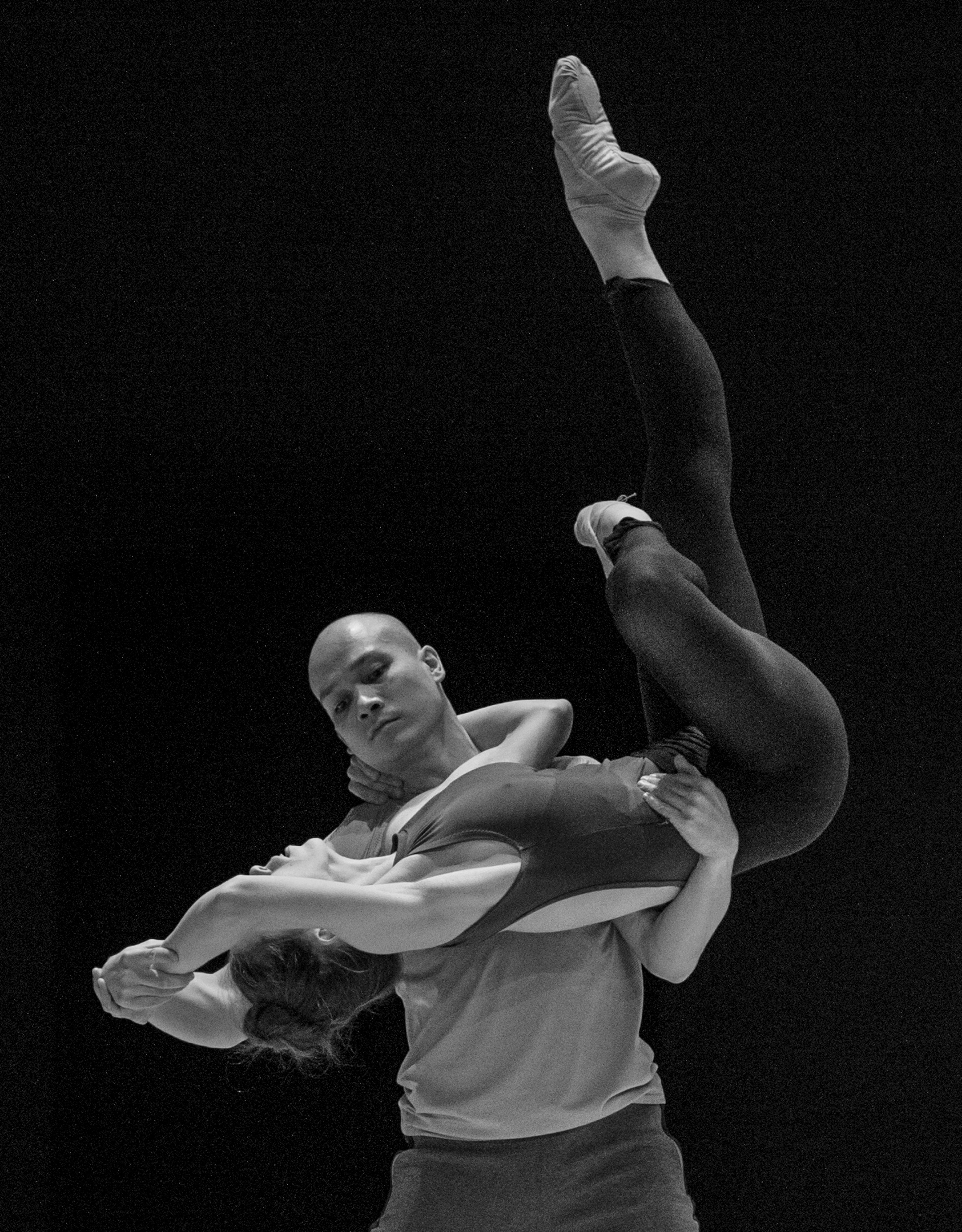
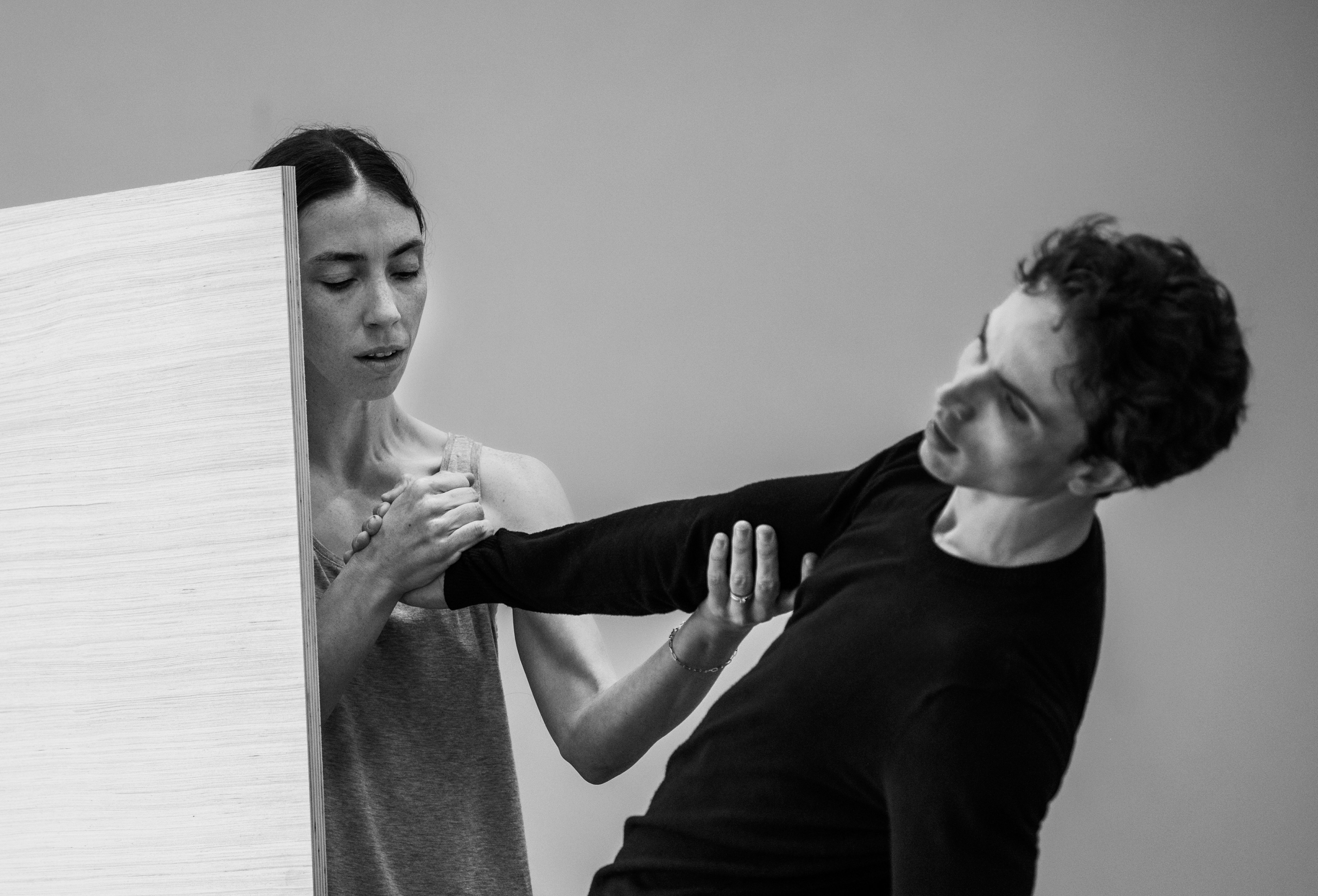
The piece is built around a male protagonist, and it is his journey that shapes the narrative. Those familiar with Samantha’s earlier choreography will recognize Dutch dancer Douwe Dekkers, also a soloist with the Norwegian National Ballet, and the artist she has created all her works with.
– He hates the word, but he is my muse, Samantha laughs. – I would never have come close to being the choreographer I am without him.
– We’ve found a way of working that is sincere and deeply rooted in the love for what we do. He has had enormous influence on who I am, and that’s why I created this for him.
Aarne Kristian Ruutu—whom Samantha describes as “one of the most phenomenal contemporary dancers ever to perform on the Opera House main stage”—has joined the process as ballet master. She says he has been essential in helping the work become what she hopes it can be:
– Working with him in the studio has been life-changing for me. As a partner, a dancer, and a human being, he is extraordinary. When I sometimes don’t understand how to solve something, he’ll quietly say, ‘I have an idea.’ Never in a way that overshadows anything—just his humble, beautiful way of being.
A Place and a Voice
It’s a long way from Australia to Norway. The fact that Samantha ended up with the Norwegian National Ballet in Oslo is no coincidence:
– I came to the National Ballet purely because of the repertoire – the fact that the company creates so many new works, and the choreographers who actually come here and work with the dancers directly. Here I’ve learned about process and about what works for me. For me, it all comes down to three things: love for the work in the studio, a lot of hard work and energy, and respect for continually seeking and exploring movement.
– I owe this company everything, because they have truly supported my creative voice and given me room to try new things and grow into who I wanted to become. And it’s Ingrid I have to thank for that—she has believed in me every step of the way. This really is my home.
When Samantha joined the National Ballet in 2013, the year after Ingrid Lorentzen became artistic director, no female choreographer had yet created a new work for the Main Stage in Bjørvika. Much has changed since, including through the choreographic initiative ARTEMISIA. But although ballet history is undeniably dominated by male voices, that doesn’t mean they are the only ones who have gained ground.
– Many of the choreographers I look up to are women – Pina Bausch, Sharon Eyal, Ina Christel Johannessen… And some of the best studio experiences I’ve had have been working with female choreographers like Crystal Pite and Sol León, artists with powerful yet vulnerable voices. They’ve had a huge influence on me.
– I feel an enormous responsibility to create something that holds up. I put pressure on myself not to think too much about this responsibility, but as a female choreographer I want to represent both the strength and the vulnerability we bring into a process.

McGregor/
Lynch